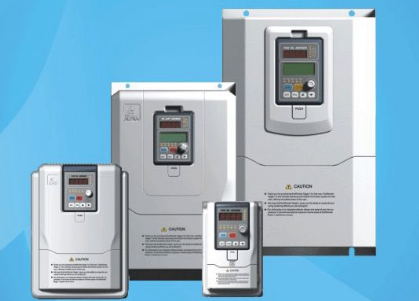
What isfrequency converterThis thing is: AC – DC – AC (it can also be said that it is rectified first – then inverted), and the frequency converter that goes through this process is also calledAC right and right frequency conversion, which is currently used more in various industries. In addition, there is one moreCommunication – communication is transformed, which is also calledAlternating frequency converter。
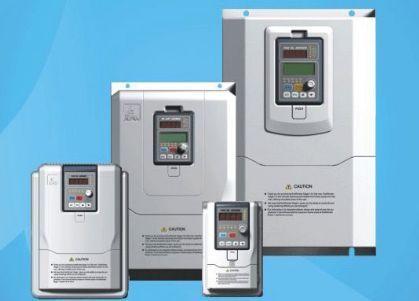
1. What is a frequency converter?
The frequency converter is an electrical energy control device that uses the power frequency power supply to another frequency by using the on/off effect of power semiconductor devices. The frequency converter is mainly composed of rectification (AC to DC), filtering, inverter (DC to AC), brake unit, drive unit, detection unit, microprocessing unit, etc.
The frequency converter is the equipment that converts the power frequency power supply (50Hz or 60Hz) into AC power supply of various frequencies to realize the variable speed operation of the motor, in which the control circuit completes the control of the main circuit, the rectifier circuit converts the AC power into DC power, the DC intermediate circuit smoothly filters the output of the rectifier circuit, and the inverter circuit reverses the DC power into AC power. For such asVector controlFor frequency converters that require a lot of calculations, sometimes a CPU for torque calculation and some corresponding circuits are also required. Frequency conversion speed regulation is to achieve the purpose of speed regulation by changing the frequency of power supply from the motor stator winding.
2. The principle of frequency converter
In embedded development, it often involves the control of the motor, and the current frequency conversion control of AC motors is very widely used, so let’s briefly look at the diagram to introduce the frequency converter, assuming that you already understand the principle of the motor.
The block diagram is as follows:
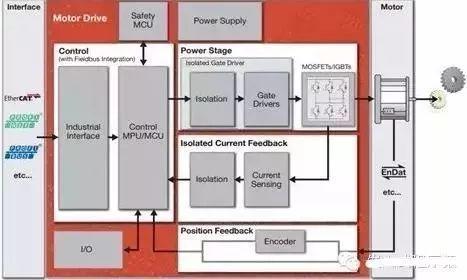
The frequency converter is mainly composed of rectification (AC to DC), filtering, inverter (DC to AC), brake unit, drive unit, detection unit, microprocessing unit, etc. The frequency converter is internalIGBTThe switching and disconnecting to adjust the voltage and frequency of the output power supply, according to the actual needs of the motor to provide the required power supply voltage, so as to achieve the purpose of energy saving and speed regulation, in addition, the frequency converter also has many protection functions, such as over-current, over-voltage, overload protection, etc. With the continuous improvement of industrial automation, frequency converters have also been widely used.
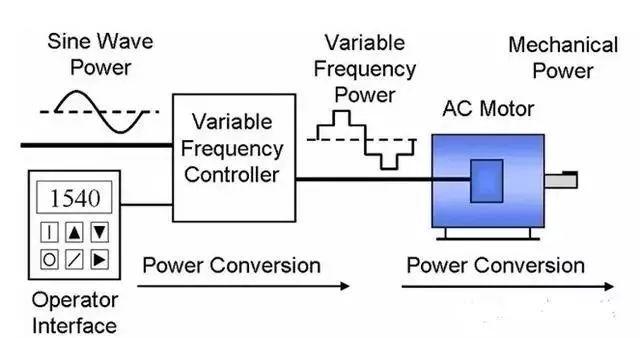
A typical inverter system diagram is shown below. It mainly includes the operation panel, VFD controller, motor and other parts
1. Typical structure:
It mainly includes: control platform, measurement circuit, power circuit, protection circuit, etc
There are two types of common frequency converters: voltage type and current type, of which the power inverter part mostly uses IGBT andIGCTEqual power tube.
2. Typical algorithms:
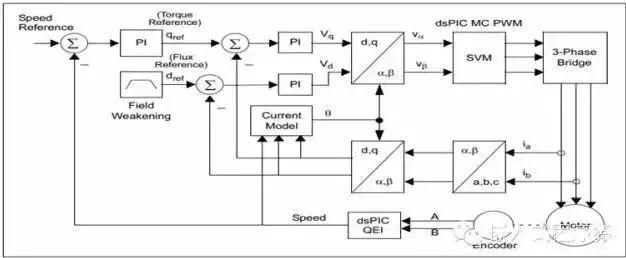
Among them, the control algorithm represented by Siemens is mainly based onCoordinate transformation(vector control), the algorithm represented by ABB Interested friends can find the information by themselves to obtain (Direct torque controlI won’t repeat it here.
3. Vector control:
Many chip MCUs and MPU manufacturers have given block diagrams and algorithm libraries for frequency conversion vector control, and those who are interested can study and study, such as the figure belowMicrochip Technology(Microchip).
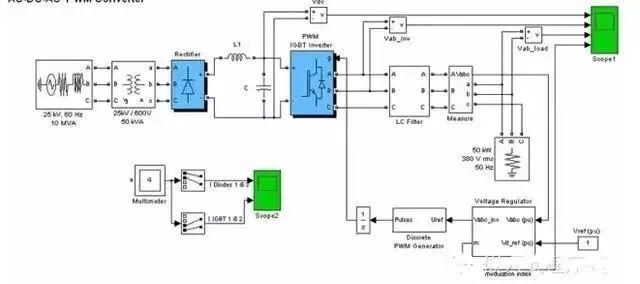
We can simulate the algorithm on Matlab.
3. The role of frequency converter
1. Frequency conversion energy saving
The energy saving of frequency converters is mainly reflected in the application of fans and pumps. In order to ensure the reliability of production, various production machinery has a certain surplus when designing and matching power drives. When the motor cannot run at full load, in addition to meeting the power drive requirements, the excess torque increases the consumption of active power, resulting in the waste of electrical energy. The traditional speed regulation method of fans, pumps and other equipment is to adjust the air supply volume and water supply volume by adjusting the opening of the baffle and valve at the inlet or outlet, and its input power is large, and a large amount of energy is consumed in the interception process of the baffle and valve. When using frequency conversion speed regulation, if the flow requirement is reduced, the requirement can be met by reducing the speed of the pump or fan.
The purpose of the electric motor is to regulate the speed and reduce the starting current. In order to generate variable voltage and frequency, the device first converts the alternating current of the power supply into direct current (DC), a process called rectification. A device that converts direct current (DC) into alternating current (AC) has the scientific term for an inverter. Generally, inverters convert DC power into inverter power sources with a certain fixed frequency and a certain voltage. For inverters with adjustable frequency and adjustable voltage, we call them frequency converters. The waveform output by the frequency converter is an analog sine wave, which is mainly used for speed regulation of three-phase asynchronous motors, also known as frequency conversion speed governors. For variable frequency inverters with high waveform requirements mainly used in instrumentation testing equipment, the waveform should be sorted out, and a standard sine wave can be output, which is called a frequency conversion power supply. Generally, the inverter power supply is 15-20 times the price of the inverter. Since the main device that generates the voltage or frequency of the variation in the frequency converter equipment is called “inverter”, the product itself is named “inverter”, that is: frequency converter.
Frequency conversion is not everywhere to save power, and there are many occasions where frequency conversion may not necessarily save electricity. As an electronic circuit, the frequency converter itself also consumes power (about 3-5% of the rated power). A 1.5 hp air conditioner consumes 20-30W of electricity, which is equivalent to a permanent lamp. It is a fact that the frequency converter runs at power frequency and has a power-saving function. But his prerequisites are:
First, high power and fan/pump load;
second, the device itself has a power-saving function (software support);
Variable-frequency drive (VFD) is a power control device that uses variable frequency technology and microelectronic technology to control the AC motor by changing the frequency of the motor working power supply. The frequency converter is mainly composed of rectification (AC to DC), filtering, inverter (DC to AC), brake unit, drive unit, detection unit, microprocessing unit, etc. The frequency converter relies on the internal IGBT to adjust the voltage and frequency of the output power supply, and provides the power supply voltage it needs according to the actual needs of the motor, so as to achieve the purpose of energy saving and speed regulation. With the continuous improvement of industrial automation, frequency converters have also been widely used.


https://shorturl.fm/oQ6iP